Jeremy’s IT Lab lecture video:
Commands
Commands List
EtherChannel Show Commands
7. EtherChannel
Link to original
- show etherchannel
- show etherchannel summary
-->Shows a summary of current EtherChannels- show etherchannel port-channel
-->Like the summary command, but it shows the current EtherChannel protocol as well (LACP/PAgP)- show etherchannel load-balance
-->Shows current EtherChannel load balancing methodEtherChannel Interface Commands
EtherChannel
Link to original
- interface port-channel etherchannel-group-number
-->Enters EtherChannel group configuration mode (or creates an EtherChannel port if it doesn’t exist)
- interface ponumber
-->Shorter version ofinterface port-channel- channel-group etherchannel-group-number mode mode { desirable
/auto/active/passive/on }
- (active/passive are LACP modes, while desirable/auto are PAgP modes, on is static etherchannel)
- channel-protocol protocol (lacp
/pagp)- port-channel load-balance method { src-mac
/dst-mac/src-dst-mac/src-ip/dst-ip/src-dst-ip }-->Changes the EtherChannel load balancing method
EtherChannel Information
EtherChannel is a technology that groups multiple physical interfaces together to act as a single logical interface.
- Traffic using the EtherChannel will be load balanced among the physical interfaces in the group through an algorithm.
- STP will treat EtherChannel groups as ONE single interface, rather than applying STP rules on each interface individually
Other names for EtherChannel
- Port Channel
- LAG (Link Aggregation Group)
Example: STP functionality and EtherChannels
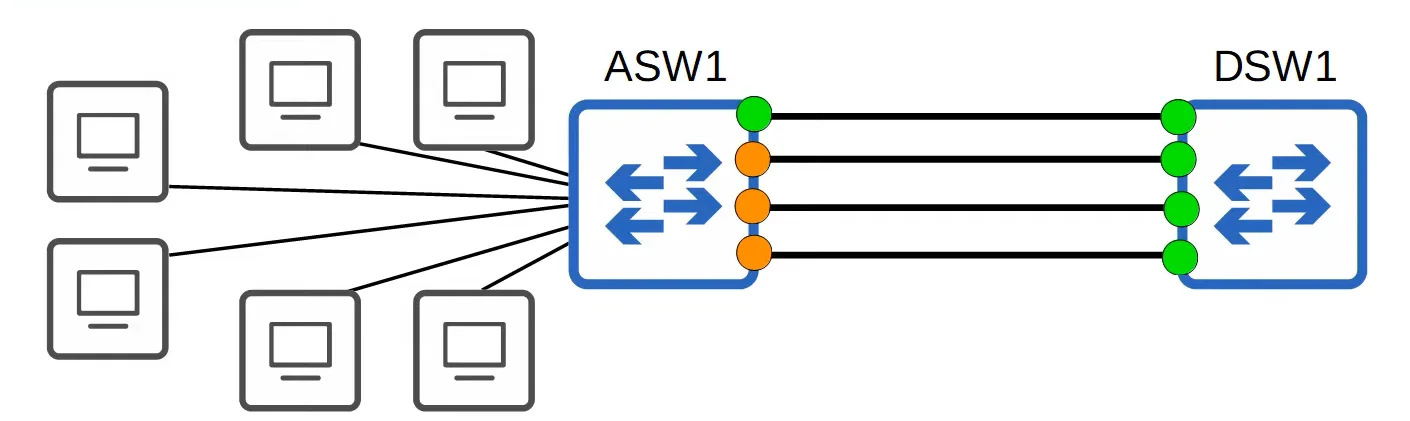
Without EtherChannels:
- If you connect two switches together with multiple links, all except one will be disabled by spanning tree.
- If all of ASW1’s interfaces were forwarding, Layer 2 loops would form between both switches, leading to broadcast storms.
- The alternate ports will remain unused and in a discarding/blocking state, unless the current active link fails.
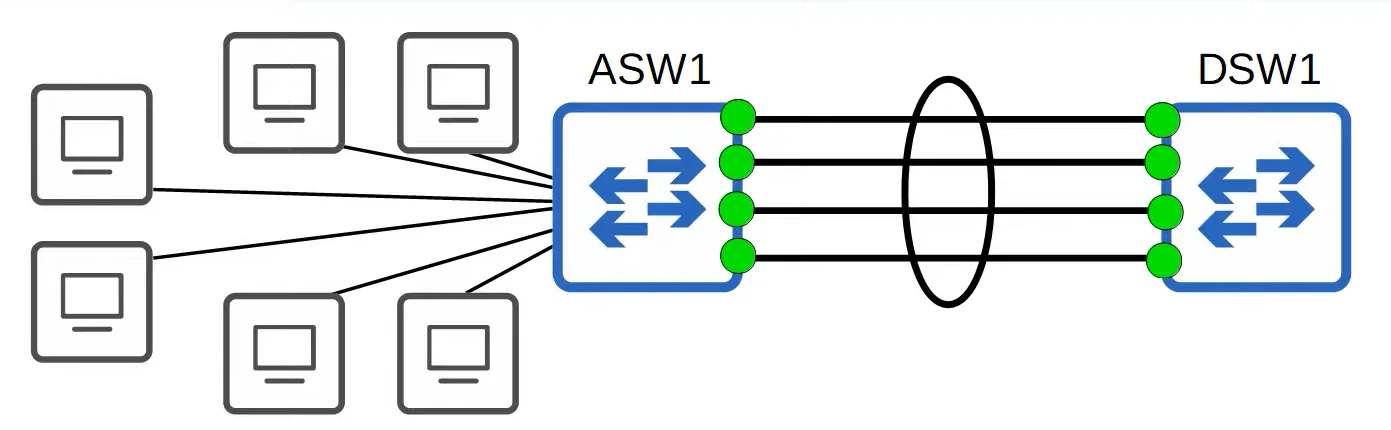
With EtherChannels
- EtherChannel groups these physical interfaces together to act as one single logical interface.
- STP will also treat this group as a single interface.
EtherChannel Load-Balancing
EtherChannel load balances based on ‘flows’
- A flow is a communication between two nodes in the network.
- Frames in the same flow will be forwarded using the same physical interface.
- If frames in the same flow were forwarded out of different physical interfaces, some of the frames could arrive at the destination out of order, which can cause problems.
You can change the method of the load-balancing / interface selection calculation to one of these 6 modes through the port-channel load-balance METHOD command:
- Source MAC (src-mac)
- Destination MAC (dst-mac)
- Source AND Destination MAC (src-dst-mac)
- Source IP (src-ip)
- Destination IP (dst-ip)
- Source AND Destination IP (src-dst-ip)
EtherChannel Protocols
There are three EtherChannel protocols on Cisco switches.
- PAgP (Port Aggregation Protocol)
- Cisco proprietary protocol.
- Dynamically negotiates the creation and maintenance of the EtherChannel. (like DTP)
- LACP (Link Aggregation Control Protocol) (802.3ad)
- Industry standard protocol.
- Dynamically negotiates the creation and maintenance of the EtherChannel. (like DTP)
- Static EtherChannel
- A protocol isn’t used to determine if an EtherChannel should be formed.
- Interfaces are statically configured to form an EtherChannel.
EtherChannel Protocol Modes
- PAgP: Desirable and Auto
- Auto + Auto = ==No== EtherChannel
- Desirable + Auto = EtherChannel
- Desirable + Desirable = EtherChannel
- LACP: Active and Passive
- Passive + Passive = ==No== EtherChannel
- Active + Passive = EtherChannel
- Active + Active = EtherChannel
- On/Static: on
- On mode only works with on mode and is not compatible with LACP or PAgP.
Maximum group size for EtherChannels
- Up to 8 interfaces can be formed into a single EtherChannel
- LACP allows up to 16, but only 8 will be active, while the other 8 will be in standby mode, ready to take over when an active interface fails.
EtherChannel Configurations
EtherChannels can be created with the interface port-channel GROUP-NUMBER command or interface poNUMBER command.
Then, they can be assigned to interfaces with the channel-group GROUP-NUMBER mode MODE command.
You can also limit the usable EtherChannel modes to the ones of a specific protocol (ie. PAgP) with the channel-protocol PROTOCOL command.
- Member interfaces in the same EtherChannel need to have the same configurations as each other, otherwise, they will be excluded from the EtherChannel group.
- These configurations are:
- Same speed
- Same duplex (full/half)
- Same switchport mode (access/trunk)
- Same allowed VLANs/native VLAN (for trunk interfaces)
channel-protocol command
- Using the
channel-protocol PROTOCOLcommand will limit the usable EtherChannel modes to the ones of that protocol.- For example, using LACP will limit you to Active and Passive modes only. Even static/on EtherChannel will not be a usable mode on the EtherChannel interfaces.
channel-group numbers matching
- In the
channel-group GROUP-NUMBER mode MODEcommand, the channel-group group-number has to match for the member interfaces on the same switch.- However, it doesn't have to match the channel-group group-number on the other switch.
(channel-group 1 on ASW1 can form an EtherChannel with channel-group 2 on DSW1)
Jeremy’s IT Lab előadásvideó:
Parancsok
Parancslista
EtherChannel Show Parancsok
7. EtherChannel
Eredeti hivatkozása
- show etherchannel
- show etherchannel summary
-->Összefoglalót jelenít meg az aktuális EtherChannelekről- show etherchannel port-channel
-->Hasonló a summary parancshoz, de megjeleníti az aktuális EtherChannel protokollt is (LACP/PAgP)- show etherchannel load-balance
-->Megjeleníti az aktuális EtherChannel terheléselosztási módszert (load balancing method)EtherChannel Interfész Parancsok
EtherChannel
Eredeti hivatkozása
- interface port-channel etherchannel-group-number
-->Belép az EtherChannel csoport konfigurációs módjába (vagy létrehozza a Port-Channel interfészt, ha még nem létezik)
- interface ponumber
-->Azinterface port-channelrövidebb formája- channel-group etherchannel-group-number mode mode { desirable
/auto/active/passive/on }
- (Az active/passive a LACP módjai, míg a desirable/auto a PAgP módjai, az on pedig a statikus EtherChannel)
- channel-protocol protocol (lacp
/pagp)- port-channel load-balance method { src-mac
/dst-mac/src-dst-mac/src-ip/dst-ip/src-dst-ip }-->Megváltoztatja az EtherChannel terheléselosztási módszerét
EtherChannel Információk
Az EtherChannel egy olyan technológia, amely több fizikai interfészt fog össze egyetlen logikai interfészként való működésre.
- Az EtherChannel-t használó adatforgalom egy algoritmus alapján terheléselosztásra (load balancing) kerül a csoport fizikai interfészei között.
- Az STP az EtherChannel csoportokat EGYETLEN logikai interfészként kezeli ahelyett, hogy az STP szabályokat külön-külön alkalmazná az egyes fizikai interfészekre.
Az EtherChannel egyéb elnevezései
- Port Channel
- LAG (Link Aggregation Group)
Példa: STP működés és az EtherChannelek
EtherChannelek nélkül:
- Ha két switchet több linkkel kötünk össze, egy kivételével mindegyiket letiltja a spanning tree.
- Ha az ASW1 összes interfésze forwarding állapotban lenne, Layer 2 loopok alakulnának ki a két switch között, ami broadcast viharokhoz (broadcast storms) vezetne.
- Az alternate portok használaton kívül maradnak discarding/blocking állapotban, kivéve, ha az aktív kapcsolat meghibásodik.
EtherChannelekkel:
- Az EtherChannel összefogja ezeket a fizikai interfészeket, hogy egyetlen logikai interfészként viselkedjenek.
- Az STP ezt a csoportot szintén egyetlen interfészként kezeli.
EtherChannel Terheléselosztás (Load-Balancing)
Az EtherChannel a forgalmi folyamok („flows”) alapján osztja el a terhelést.
- A flow (folyam) a hálózat két csomópontja közötti kommunikáció.
- Az azonos flow-hoz tartozó frame-ek mindig ugyanazon a fizikai interfészen keresztül kerülnek továbbításra.
- Ha az azonos flow-ba tartozó frame-eket különböző fizikai interfészeken továbbítanák, egyes frame-ek nem a megfelelő sorrendben (out of order) érkezhetnének meg a célállomásra, ami hibákat okozhat.
A terheléselosztási / interfész-kiválasztási számítás módszerét az alábbi 6 mód valamelyikére módosíthatjuk a port-channel load-balance METHOD paranccsal:
- Source MAC (src-mac)
- Destination MAC (dst-mac)
- Source és Destination MAC (src-dst-mac)
- Source IP (src-ip)
- Destination IP (dst-ip)
- Source és Destination IP (src-dst-ip)
EtherChannel Protokollok
Háromféle EtherChannel protokoll létezik Cisco switch-eken:
- PAgP (Port Aggregation Protocol)
- Cisco-specifikus (proprietary) protokoll.
- Dinamikusan tárgyalja le az EtherChannel létrehozását és karbantartását (hasonlóan a DTP-hez).
- LACP (Link Aggregation Control Protocol) (802.3ad)
- Ipari szabványos protokoll.
- Dinamikusan tárgyalja le az EtherChannel létrehozását és karbantartását (hasonlóan a DTP-hez).
- Statikus EtherChannel
- Nem használ protokollt annak eldöntésére, hogy létrejöjjön-e az EtherChannel.
- Az interfészek statikusan vannak beállítva az EtherChannel alkotására.
EtherChannel Protokoll Módok
- PAgP: Desirable és Auto
- Auto + Auto = ==Nincs== EtherChannel
- Desirable + Auto = EtherChannel
- Desirable + Desirable = EtherChannel
- LACP: Active és Passive
- Passive + Passive = ==Nincs== EtherChannel
- Active + Passive = EtherChannel
- Active + Active = EtherChannel
- On/Statikus: on
- Az On mód kizárólag egy másik on móddal működik, és nem kompatibilis sem a LACP, sem a PAgP protokollokkal.
Maximális csoportméret EtherChannelek esetén
- Legfeljebb 8 interfész fogható össze egyetlen EtherChannel csoportba.
- A LACP legfeljebb 16 interfészt engedélyez, de csak 8 lesz aktív, míg a másik 8 készenléti (standby) állapotban vár arra, hogy egy aktív interfész meghibásodása esetén átvegye a helyét.
EtherChannel Konfigurációk
Az EtherChannelek az interface port-channel GROUP-NUMBER vagy az interface poNUMBER paranccsal hozhatók létre.
Ezután a fizikai interfészekhez a channel-group GROUP-NUMBER mode MODE paranccsal rendelhetők hozzá.
A használható EtherChannel módokat egy adott protokollra (pl. PAgP) is korlátozhatjuk a channel-protocol PROTOCOL paranccsal.
- Az azonos EtherChannel-ben lévő taginterfészeknek (member interfaces) egymással megegyező konfigurációval kell rendelkezniük, különben kizárásra kerülnek az EtherChannel csoportból.
- Ezek a megegyező paraméterek:
- Azonos sebesség (speed)
- Azonos duplex (full/half)
- Azonos switchport mód (access/trunk)
- Azonos engedélyezett VLAN-ok / native VLAN (trunk interfészek esetén)
A channel-protocol parancs
- A
channel-protocol PROTOCOLparancs használata az adott protokoll módjaira korlátozza a választható EtherChannel módokat.- Például a LACP használatakor kizárólag az Active és Passive módok lesznek elérhetők. Még a statikus/on EtherChannel sem lesz használható mód az EtherChannel interfészeken.
A channel-group számok egyezése
- A
channel-group GROUP-NUMBER mode MODEparancsban a channel-group group-number azonos kell legyen az ugyanazon a switchen lévő taginterfészeknél.- Azonban nem szükséges megegyeznie a másik switch channel-group csoportszámával.
(Az ASW1-en lévő channel-group 1 képes EtherChannel-t alkotni a DSW1-en lévő channel-group 2-vel)